Wednesday, July 9, 2014

Who Should I Notify of My Change of Address?

You would think that in this digital era where your address is assuming to have an “@“ in it instead of a Zip code, that change-of-address notifications would be obsolete.

You would think.

The reality is the opposite. Because we don’t get much in the mail anymore, we forget how important it is to update our mailing address with credit card companies and others that we do business with.

If you get only occasional snail-mail from a company, you run the risk of getting mail with sensitive financial information long after your mail forwarding has expired, which means personal, private information will go to the current residents of your old address.

After you know what your new address will be, but before you move, make a list of people and companies that will need your new address. Take some time with your list, allowing yourself to remember the more obscure people.

Because your current address needs to be on file


Any bills that you pay online, bills that you have set up as automatically paid (auto-pay both through the account itself or through your bank), and bills that you receive via email should all be updated with your physical mailing address.

Don’t forget your investment accounts or any other financial institutions that you have accounts with.

Even if you do all of your banking online and haven’t stepped foot into your local branch in years, be sure your bank has your new address and phone number.

Because you’ll need to receive refunds, final bills, and other “closing out” tasks


Leaving town without giving everyone your new address is tantamount to “skipping town,” especially with businesses. Don’t rely on mail forwarding, which adds delays and may cause problems with due dates.

Be sure to notify all of your “old” contacts with your new address:

* Utilities at your old house - For refunds of deposits, final bills and other issues in closing out your old account.

* Newspapers and other publications delivered to your house

* Your doctors, dentist, and other medical professionals - Even if you’re not a current patient, you always want your health care professionals to be able to reach you.

* Your children’s school - For records, things left behind, and even yearbooks.

* Exterminators, lawn care providers, and other home services - For refunds of deposits, final bills and other issues in closing out your old account.

Because your address is still just plain important


Credit cards - Don’t forget about the cards that you have tucked away in your wallet and rarely use. If you don’t update your address, expiration alerts and other notifications will go undelivered. Not to mention the risk of not receiving a bill, if you should suddenly decide to use it.

New house utilities - This one’s easy. You’ll have to give your new address when you sign up for utilities.

Cell phone provider

Magazines - Changing a magazine delivery address used to be an ordeal that took months to take effect. It’s a lot easier now. Most magazines have online address change forms.

Insurances: Health, Car and Life - Because you aren’t billed very often for insurance premiums,

Car payment - Because many vehicle loans are auto-paid, don’t forget this one.

All loans

The IRS - Uncle Sam needs to know where you live!

The Department of Motor Vehicles - Especially if you’re moving in-state and will keep your state driver’s license, but also if you’re moving out of state and will be delayed in obtaining a new license.

Just because!


If you’re moving anytime in the latter half of the year, you can kill two birds with one stone by including a change of address with your holiday cards.

Then go through your address book or contacts and notify friends and family of your new digs. There are some fun ways to let friends know that you’ve moved. Check these out!

And don’t forget your alma mater! Your high school and college loves to keep track of their grads and will appreciate you keeping them updated.


~~~

If you like Diane's humorous take on moving, you'll love her book Home Sweet Homes: How Bundt Cakes, Bubble Wrap, and My Accent Helped Me Survive Nine Moves.

Wednesday, July 2, 2014

Smells That Sell


The first house I sold, my Realtor told me to bake chocolate chip cookies the day of our open house. "The smell of cookies baking makes people nostalgic," he said. Ah, if it were only that easy!

The smell of your house, while only one factor in making it desirable to buyers, is still an important one, and playing to house-hunters' sense of smell can improve their overall opinion of your home.

But unless you live in a seller's dream market, you're going to have to think beyond chocolate chip cookies if you want a smell that sells.

It's generally agreed that strong, artificial air freshening smells are a no-no in home selling. Strong potpourri, air fresheners and sprays will make home buyers suspicious. They'll know it's hiding something and will become preoccupied wondering what that is.

Every home buyer is different, with different tastes, allergies, turn-ons and turn-offs. For every buyer who loves cinnamon sticks simmering on the stove, there are two who say they'd turn around the walk out the door. So the challenge is to be neutral and appeal to the widest spectrum of buyers as possible.

Smells people don’t like


Almost everyone is offended by strong artificial smells that scream out, “I’m masking something horrid!” like:

Glade plug-ins and other air freshening gimmicks
Potpourri
Strong scented candles
Garlic
Strong, ethnic food with unusual ingredients

The thing is, no smell is immune from offending someone, either because of personal taste, sensitive noses, or allergic reactions.

One woman on this real estate forum said, “If someone boiled cloves and oranges or anything with cinnamon, I would probably turn around and head out. That house would be off the list for me.” Now, you as the seller might adore a citrusy-clove-cinnamon smell, but you’d be wise to think about the diverse market out there, and go neutral.

Smells most people like


Hardly anyone is put off by light - and I stress light - smells of:

Fresh paint
Murphy’s Oil Soap
Windex
“Generally clean,” but not bleach
Mint
Freshly baked bread or baked goods, but not too sweet
Natural lemon

As long as it's not too overwhelming, home sellers have had success with dabbing some lemon oil (not the cleaning kind) on a couple of light bulbs in the house. If you really want to simmer cinnamon, cloves, allspice and bay leaves on the stove, do it for a short period of time, well before your open house or showing appointment.

Whatever odor-masking methods you use, be sure to open the doors and windows and let fresh air in to neutralize it.

The #1 can’t-go-wrong best smell for your house


Easy: There’s a general consensus that the best smell in a stranger’s house is:

Nothing

If you don’t own pets, you’re a non-smoker, and you keep a clean home, you can easily have a house that smells like Nothing.

Clean your furnace filters, have the house professionally cleaned, and avoid cooking strongly aromatic foods when you’re house is on the market.  Remember, the smells that you love may not be as adored by prospective buyers.

How to deodorize your house for sale


* Kitchens are the hotbed of odors in a home. Clean your oven to get rid of any fish dinner smells, but do it in advance. The smell of oven cleaner isn't a favorite of many people, either.

* Sniff near sink drains. If there are any lingering odors, sanitize them with cleanser and lemon.

* Don't forget the laundry room and anywhere laundry sits in a hamper.

* Clean and air out the basement the best you can, to get rid of any musty or moldy smells.

* If you have a child in diapers, be sure to empty the diaper pail often and air out the nursery.

* And if you have pets, be especially aware that non-pet-owners will detect pet smells better than you.

For more good scents sense, check out this article from Lillian Montalto "Using Scents to Help Sell Your Home."


~~~

If you like Diane's humorous take on moving, you'll love her book Home Sweet Homes: How Bundt Cakes, Bubble Wrap, and My Accent Helped Me Survive Nine Moves.


Wednesday, June 25, 2014

Home Sweet Hotel

Think about your last hotel stay. Indoor pool ... lots of leisure time ... maybe room service ... freedom from housework ... the whole vacation mentality.  But what if that hotel room was your home - your only home - for six months?

For the Zorellas of Canfield, Ohio, and other families who have lost their homes from fire and other disaster, hotel living is all the home they get for stretches of time that go beyond a vacation.

The Zorella family lived in a Hampton Inn for six months after their house burned to the ground in 2007.  The way that the family coped with the drawn-out life of limbo can probably be summed up by Joyce Zorella's attitude of gratitude.

“The way it turned out, I can’t complain. We had no loss of life.”

The fire


Joyce remembers it as a typical Ohio winter morning. “We had a beautiful fire in the fireplace,” she recalls. Her husband was at work, her daughter was away, and her 15-year-old son was on the couch in front of the fireplace.

“He came up to tell me that smoke was coming from the fireplace,” Joyce said. “I thought it was just a minor venting problem and that it would go away.” A few minutes later when she got downstairs, there was more smoke, so she opened the patio door to air out the room. At that moment, the roof collapsed.

The fire had been raging inside the walls of the house due to a faulty fireplace. Joyce and her son had just enough time to call 911 and run out the door with their dog, carrying nothing with them. The fire department arrived quickly, but the hydrants were frozen. “We had to stand there and watch as our house burned,” Joyce said.

She recounts heartbreaking details about the fire - keeping her son from trying to go back into the house to get a suit he planned to wear to a school dance that night, realizing every family photo was gone, every memento,  watching flames engulf their home and everything they owned - and then she says something unexpected: “We feel lucky,” a mantra she repeats throughout her story.

Hotel living


The family stayed with Joyce’s mother for about a week and then they chose a two-room suite at the Hampton Inn as their temporary home while a new house was being built for them.

“I cried when we first got there,” Joyce said. Six months later, she cried when they left the hotel.  “They had become like family to us.”

Karen Naffah, who runs the Hampton Inn & Suites, where the Zorellas lived, said she and her staff try to make the hotel an extension of the families' homes.

"We bake cookies at 4:00, we learn all their names and what they are interested in. We have the TV in the lobby on the stations that their children would watch after school," Naffah said.  "If it's the holidays we make sure every family has tree time for opening gifts."

They may not be the only hotel to offer such services to long-term guests, but Naffah said, "We do go the extra mile. Our staff rocks that mid-America hospitality!"

The challenges


Despite extra TLC, there are challenges to hotel living, including eating at restaurants every meal, every day.   “Your digestive system has to adjust to that,” Joyce laughed. “And then it has to adjust back to home cooking after six months.”

Second only to having no kitchen was having little space. “Especially when we started to buy things to replace what we had lost,” Joyce said. “And then we started to buy things for our new house and there just wasn’t anywhere to put all of it.”

Her son lived part of the time with his girlfriend’s parents, which solved some living space issues at the hotel, but split up the family.

“Mother’s Day was hard,” Joyce recalled. Also much of their time was spent choosing things for the house, which cut into family time.

Laundry was another issue.  The hotel had one washer and one dryer, but they seemed to be always in use, so the family used the laundromat.  “Carrying your dirty underwear thoughts he lobby was a weekly event,” Joyce said, laughing.

The family lost their dog, an 8-year-old shitzu, when they gave her to a foster family during their hotel stay, and the foster family gave a fake address and disappeared. “So we saved our dog from the fire, only to lose her to a scam artist,” Joyce said.

Looking at the bright side


The Zorella Family
The family tried hard to keep things as normal as possible, something that started immediately, Joyce said. Her son went to the school dance the night of the fire. “We didn’t want anything to be different. We tried to keep things the same.”

There were wonderful amenities at the hotel, Joyce said. The lobby was the Zorellas’ living room “and we always had company,” she said.

Advice from the Red Cross


Disasters are upsetting experiences for everyone involved. Children, senior citizens, people with disabilities and people for whom English is not their first language are especially at risk and are likely to need extra care and help, according to Valerie Cole, manager of Disaster Health Services and Disaster Mental Health for the American Red Cross.

The Red Cross has this advice for those who are faced with long-term temporary living:

* Eat healthy. During times of stress, it is important that you maintain a balanced diet and drink plenty of water.

* Stay connected with family and friends. Giving and getting support is one of the most important things you can do. Try to do something as a family that you have all enjoyed in the past.

* Be patient with yourself and with those around you. Recognize that everyone is stressed and may need some time to put their feelings and thoughts in order. That includes you!

* Set priorities. Tackle tasks in small steps.

* Gather information about assistance and resources that will help you and your family members meet your disaster-related needs.

* Stay positive. Remind yourself of how you’ve successfully gotten through difficult times in the past. Reach out when you need support, and help others when they need it.

Joyce’s advice


* “Choose your hotel wisely. The staff at our hotel became friends and then became family.”

* “Keep the family close.  Something like this bonds you, because you’re in it tougher.”

* “Try to make it as an adventure. It’s not going to last. Make the best of it.”
After their new home was built, a friend had this blanket made for the Zorellas, showing their old house and their new house.


Wednesday, June 18, 2014

Be My Guest: How to Have Company


When you move to an awesome city, the first big difference you’ll see is that people will come out of the woodwork to visit you. Like someone flipped a switch, you’ll start to hear from people you worked with 20 years ago, your kids’ former math tutors whose first names you don’t even know, and distant relatives you no longer want to know. Because you’re a kind and generous soul, you’ll welcome them and invite them to stay in your guest room.

Guest rooms are almost a required amenity in San Francisco, a popular destination for conferences, conventions and vacations.  In a little over a year of living here, we’ve had almost 50 people come into town and want to see us. Half of those people stayed with us, even though we had barely had a chance to settle in to the house ourselves. Our first overnight guest arrived just a week after we moved into our house. I quickly put together our guest room and it's been in regular use since then.

I've lived in a lot of interesting cities, so I've hosted a lot of people over the years. While I've hosted every kind of guest, there's one kind of host I've tried to be: One that makes her guests feel comfortable and at home.

Here are some things to keep in mind when having company, starting with spending a night pretending you're a guest in your own home!

Be a guest in your own house

Sleep in your guest bed one night, take a shower in your guest bathroom, and put your makeup on in the mirror. Is the bed comfortable enough? Is the bedding warm enough? How is the soap and shampoo? Is the bedside light bright enough to read? How’s the wireless signal? Does that streetlight shine right onto the bed at night?

Do all the things your company does in your guest quarters and ask yourself: How would I like this, if I were staying here?

You’re not obligated to provide over-the-top luxury accommodations - after all, you’re not a five star hotel - but you should know how your guest room makes your guests feel.


Let your guests make their mark

When I lived in Florida, I had my guests sign and date a seashell and leave it in a tray in our guest room. Now that I live away from the beach, I set up an old manual typewriter in my guest room, and guests leave a message. My college friend had her guests sign their names inside the guest closet. There are lots of ideas for taking a guest book to the next, creative level, like this globe, marking all of the places your guests have arrived from. Any wedding guest book idea can be adapted for your guest room. Have fun finding what works for you and your home. Your guests will love you for it!


Be a brunch goddess

I used to count making breakfast as my least favorite thing to do when I had company. I would happily plan  dinners, stock the frig with great sandwich fixings, prep the guest room, and provide maps and  tourist info. Then the first morning would arrive and I would think, “Aw, geez, I don’t have anything to feed these people.” We’re not big breakfast eaters, so I sometimes don’t have more than three eggs in the house, and bacon rarely makes it in the front door.

So I made it a mission to master the art of brunch. My favorite brunch recipes are the ones I can put together the night before and then pop in the oven first thing in the morning.  My friend Barb’s Sausage Egg Strata became my go-to breakfast recipe for company. The day before my company arrived, I would cook the sausage and assemble the casserole, clean up the mess well in advance, and then pop the whole thing in the refrigerator. Served with cut-up fruit, it was the perfect no-fuss breakfast or brunch.

Put together your own set of brunch recipes, and be sure to have vegetarian and gluten-free versions for guests with dietary restrictions. Look on Pinterest and check out these 75 Amazing Brunch Recipes from Chef in Training.


Copy your favorite hosts

Do you have that one friend who, every time you stay with her, does an amazing job hosting? Her home is warm and inviting, you fall asleep to lavender scented pillow cases and wake to the smell of coffee and cinnamon rolls. You can be her! Take notes and be a copycat. She won’t mind. Mimicry is the highest form of flattery.


Copy your favorite hotels

While you’re taking notes on how your favorite hosts do it, jot down some things you love and hate about the hotels you’ve stayed in. I made some changes in our guest room after I was staying at a top hotel that didn’t have an electrical outlet next to the bed  for me to charge my phone nearby at night. So I went home and freed up the outlet next to the bed.


Take a tip from Airbnb

Today's Airbnb is like a cross between a hotel, a B&B, and staying with a friend. Airbnb hosts don't have access to the hospitality industry's products and services. As someone who is hosting friends overnight in your home, you can do everything that an Airbnb host does. Check out their website for ideas.


Don’t overdo it

Having company should be as much fun for you as it is for your guests. Yes, your guest room bed sheets should be clean. Yes, there should be clean towels, too. But short of that, guests don’t expect your home to be spotless. They don’t mind if the guest closet is full of your suitcases and the exercise bike that no one uses anymore (which is exactly what is filling up my guest room closet and I haven't heard a single complaint).

Your company also won't expect you to wait on them hand and foot, fix gourmet meals for them at every turn, and they shouldn't mind if you point them to the bus stop instead of chauffeuring  them on sightseeing.  So put down the dust rag, relax and have some fun!


Help your guests help themselves

If there’s room, set up a single-serve coffee maker where your guests can fix themselves that first cup in the morning. A nice bonus is a mini-frig with coffee creamer, bottled water, and canned soda. A bottle of wine and a couple glasses is always a nice touch. (Don’t forget the corkscrew!)

When your company arrives, show them where all the necessities are and tell them to help themselves. You can sleep in the morning, knowing that if your company rises before you, they’ll be fine.


Be prepared for - ahem! . . . issues

Be sure there is a plunger in every bathroom your guests will use. Also, extra toilet paper in a place that makes sense. And be sure your bathroom trash can has a few extra liners in the bottom. If something comes up, make it easy for your guests to handle it themselves, without an embarrassing plea for help.


Just do it!

Don't let yourself turn away house-guests because your house isn't perfect. Or because you don't feel you're equipped. Guests don’t care if your silverware matches, or if they have to eat at a folding table, or sleep on a couch. If they're visiting, it's likely that they want to spend time with you. Don't let yourself believe that you have to impress your guests.


More on how to have company


Prepping for Houseguests, Martha Stewart


Twelve Items Every Guest Room Needs, Organizing Junkie

~~~

If you like Diane's humorous take on moving, you'll love her book Home Sweet Homes: How Bundt Cakes, Bubble Wrap, and My Accent Helped Me Survive Nine Moves.


Wednesday, June 4, 2014

Packing Jewelry to Move

tangled-jewelry

Whether you’re moving across the globe or down the street, moving your jewelry requires some attention - not to mention a few empty toilet paper rolls.

Hastily packing your jewelry, or worse yet, putting a loaded jewelry box into a large packing box with other items, are quick fixes that will mean loads more work for you later. Unless you seriously enjoy picking apart a giant ball of necklaces, take a few easy steps to keep your jewelry safe and tangle-free.

Keep jewelry on its display and cover with Glad Press-N-Seal


jewelry move1

Be sure to use the stickiest plastic wrap, and it will require two careful hands. Simply wrap your jewelry tree or hanger with the plastic, horizontally and angled so that all the jewelry is covered. Place the whole shebang carefully in a box and pad it.


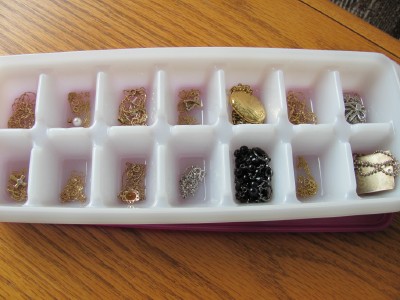
Use egg cartons or ice cube trays


jewelry move2


jewelry move6

These small compartments are perfect for rings, earrings, bendy bracelets and necklaces. Load them up and then wrap in plastic wrap.

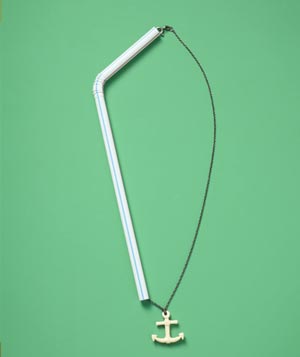
Cardboard tubes


jewelry move3

jewelry move4

Loop necklaces through a paper towel roll, toilet paper roll or the cardboard tube from a dry-cleaner hanger.

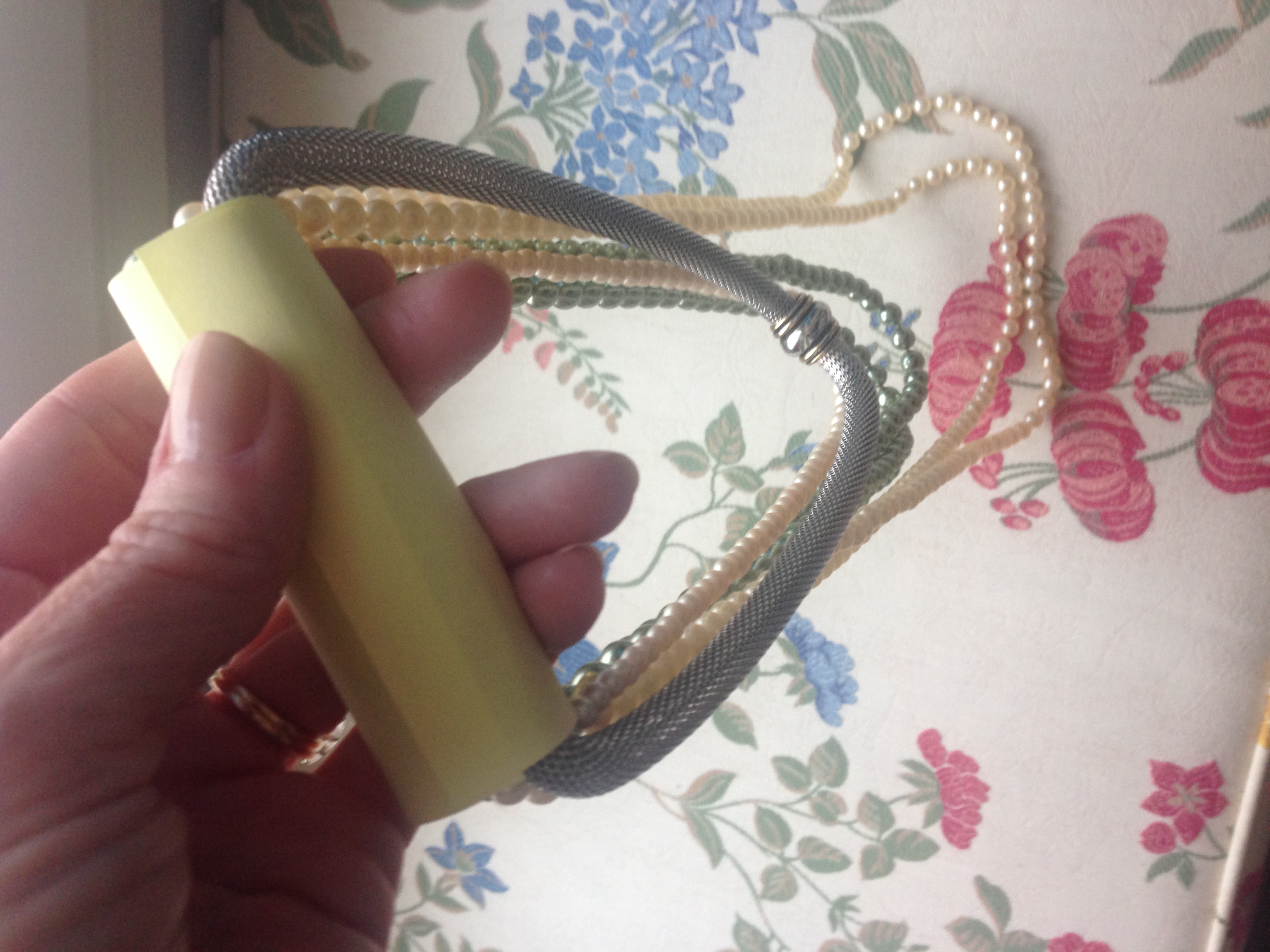
Loop a super sticky Post-It note


photo 3

If you don’t want to unclasp and reclasp necklaces to thread through a tube, just hold 5-6 necklaces together and wrap a looped Post-It note through and stick the ends together, creating a small tube.

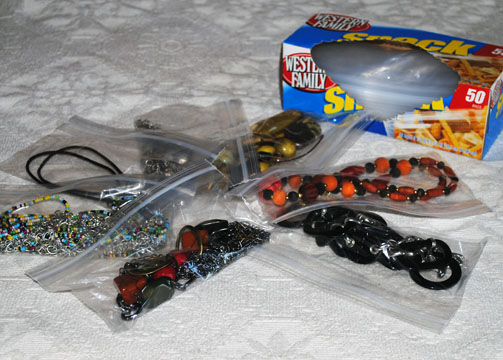
Small plastic bags


jewelry move7

What did we do before the invention of snack-sized zip bags? Put individual necklaces and jewelry in a bag - or double up but only with two items that won’t tangle. I try to save the small bags that jewelry comes in and set them aside for my jewelry when traveling.

Use a large pill organizer


jewelry move8

The larger pill organizers will easily hold chains, earrings and other delicate jewelry.

Other tips on moving jewelry


Valuable and heirloom jewelry should be packed into a box and carried with you during your move.

Keeping jewelry in its jewelry box will cause a jumbled mess. If it can’t be kept in place with plastic wrap or another method, repack it, using one of the above methods.

Here are some sources for tips on packing jewelry to move:

Organized 31


~~~

If you like Diane's humorous take on moving, you'll love her book Home Sweet Homes: How Bundt Cakes, Bubble Wrap, and My Accent Helped Me Survive Nine Moves.


Wednesday, May 28, 2014

5 Things to Remember When You're Moving With Kids

Anyone who has ever moved knows that the only thing worse than moving is moving with kids. Buying and selling houses, temporary housing, mortgage applications, packing, changing addresses and finding a new hair stylist all pale in comparison to consoling your kids over the loss of their best friends, registering them in a new school, and finding a house with the pool you promised them.

You'll feel like a symphony conductor, orchestrating all facets of your move. Your child is the diva flutist who waltzes in late with a list of demands, and refuses to play in synch with the others in the orchestra.

That's why moving with kids takes a special skill. Here are five simple things to remember when moving with kids.


1. The kids have to come first

Like everything else in your life once you bring that baby home from the hospital, you have to consider the children before yourself. You may want the stately 4-bedroom colonial, but it's not in the best school district and the neighborhood is full of retirees. You may want to set up your new kitchen first, but you're going to have to remove the pink Hello Kitty wallpaper in your son's new room first.  A month after your move, you may want to take a quick trip to the beach, but your first vacation will most likely be to your old neighborhood, so that your kids can visit their old friends.

Don't disregard your own needs and all that you have to do for the rest of the family, but when prioritizing, remember that a move is hard on children of all ages. Kids will feel a sense of urgency to get settled in, so the sooner the better.

2. There is no perfect time to move

The question Which is better, a mid-school-year move or a summer move has been bantered around since Adam and Eve moved Cain and Able out of the Garden of Eden to the wrong side of the tracks. Both have advantages and disadvantages. I'm sorry to say that there isn't a clear answer.

Some experts say summer moves are easier on kids, because when they start a new school year, they'll be in good company: Everyone is nervous about the first day of school and the "new kid" will fit in better. Summer moves are less disruptive as well, and school work is uninterrupted.

Others say that a summer move will leave your child without a way to make friends. School is an instant source of peers and new friends and without it,  your child may be lonely, missing their old friends, while even their new neighbors may be on vacation. Delaying a move can put your family in some turmoil, if some of you are separated temporarily, which causes its own stress.

If you face a decision on when during the year to move, weigh the pros and cons and consider your particular family and its needs. Most importantly, don't listen to "experts" who say there is a clear correct answer in all cases. You know your family.

3. Letting your kids make adult decisions is not a good decision

It's always a good idea to allow your kids to take part in the teamwork of moving house. It's never a good idea to go overboard.  Allowing the kids too much input into decisions involved in the move puts too much responsibility and pressure on a young person. Plus, it's inappropriate. Some parents let their guilt take over and give the kids too much leeway in decision making. In the end, this doesn't make the kids feel any better and it doesn't help the parents either.

Let your child have input in what school district they like, what neighborhood they prefer, and what house they'd like, but ultimately weigh their input with what's best. Make it clear from the beginning that you value their input and that their feelings will be considered.

Patience, one of the parenting bloggers Supersisters, suggests giving the kids some responsibilities to keep them feeling some ownership. "Give kids simple jobs to keep them feeling connected and part of the decision to move. Call family meetings to check-in with each member about how things are going and what everyone might need throughout the move," she said.

4. Be prepared to pay up

That's putting it crudely, but you know what I mean. When we moved from Ohio to Illinois, we bought a house with a hideous above-ground pool, only because we knew it would thrill the kids and get them excited about the move. Four years later when we moved to New Jersey, we looked for a house with an in-ground pool. We were determined to include at least one perk for the kids, something that would make them look forward to such a big change. You don't have to go outside your comfort zone or spend a ton of money;  just keep your eyes and ears open for something that your kids will love.

5. Weave together the old and the new

Your child's move should be the perfect combination of the comfort of familiar things and the excitement of new adventures.

"Reestablish routines as quickly as possible," advises Marie Hartwell-Walker of Psych Central. "The place will feel more like home if the rhythms of family life go on as before." At the same time, take advantage of the new things that your new area has to offer.  Consistent, familiar routines combined with something new and exciting is the best recipe for a child's smooth transition  to your new home.

More on moving children